Pure Lily flowers into organic jojoba oil using the ancient process

Oil of Lilies
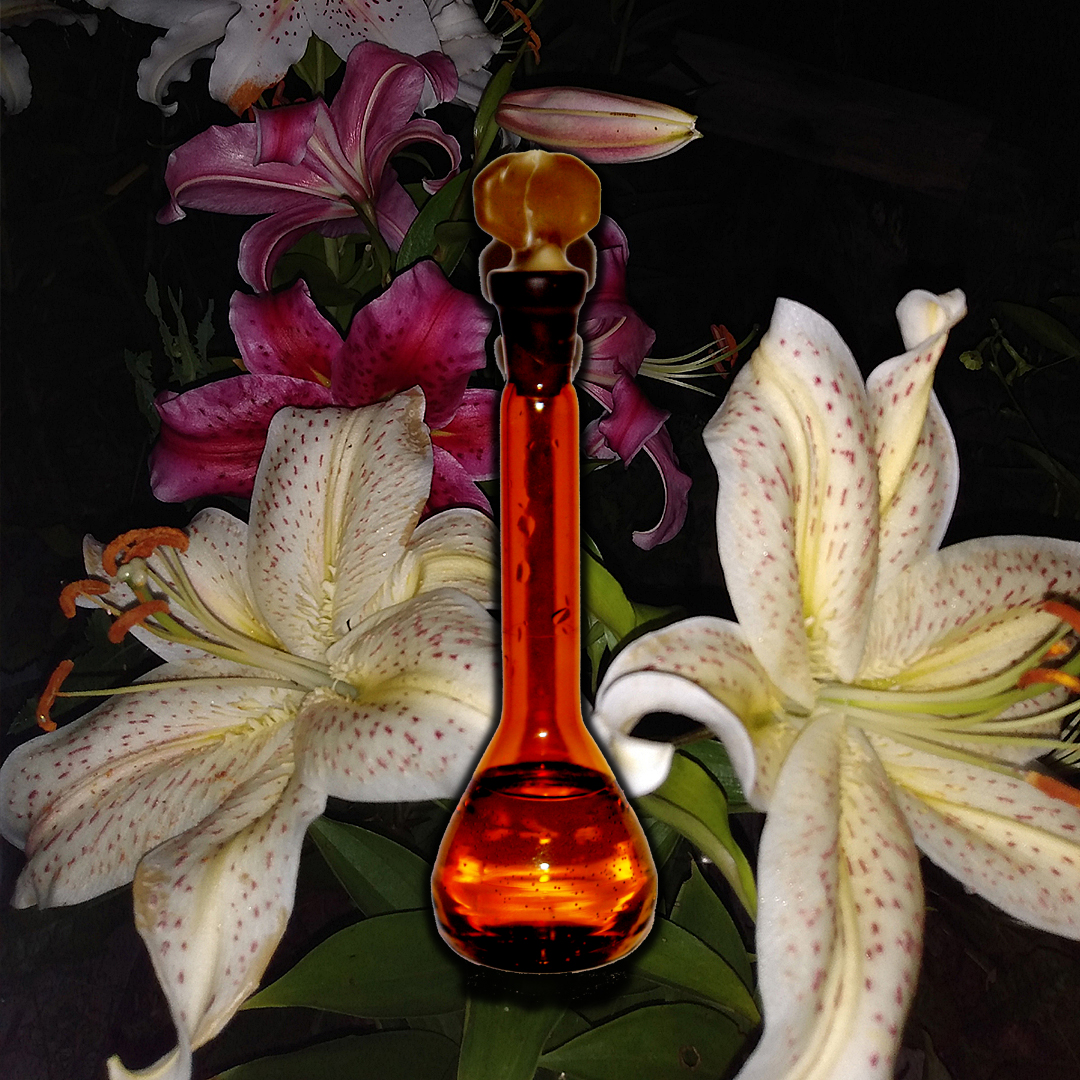
The fragrance of “Oil of Lilies” is a strong, deep and comforting, floral scent stays close to the skin and lasts for many hours. It is the throbbing heart of Lilies. Extracted over a 45-day period, with hundreds of flowers, using the ancient dual process of both maceration and enfleurage. As in the original formulas, only resins and plants are used to fix the scent. No essential oils are added.
I have two variations available:
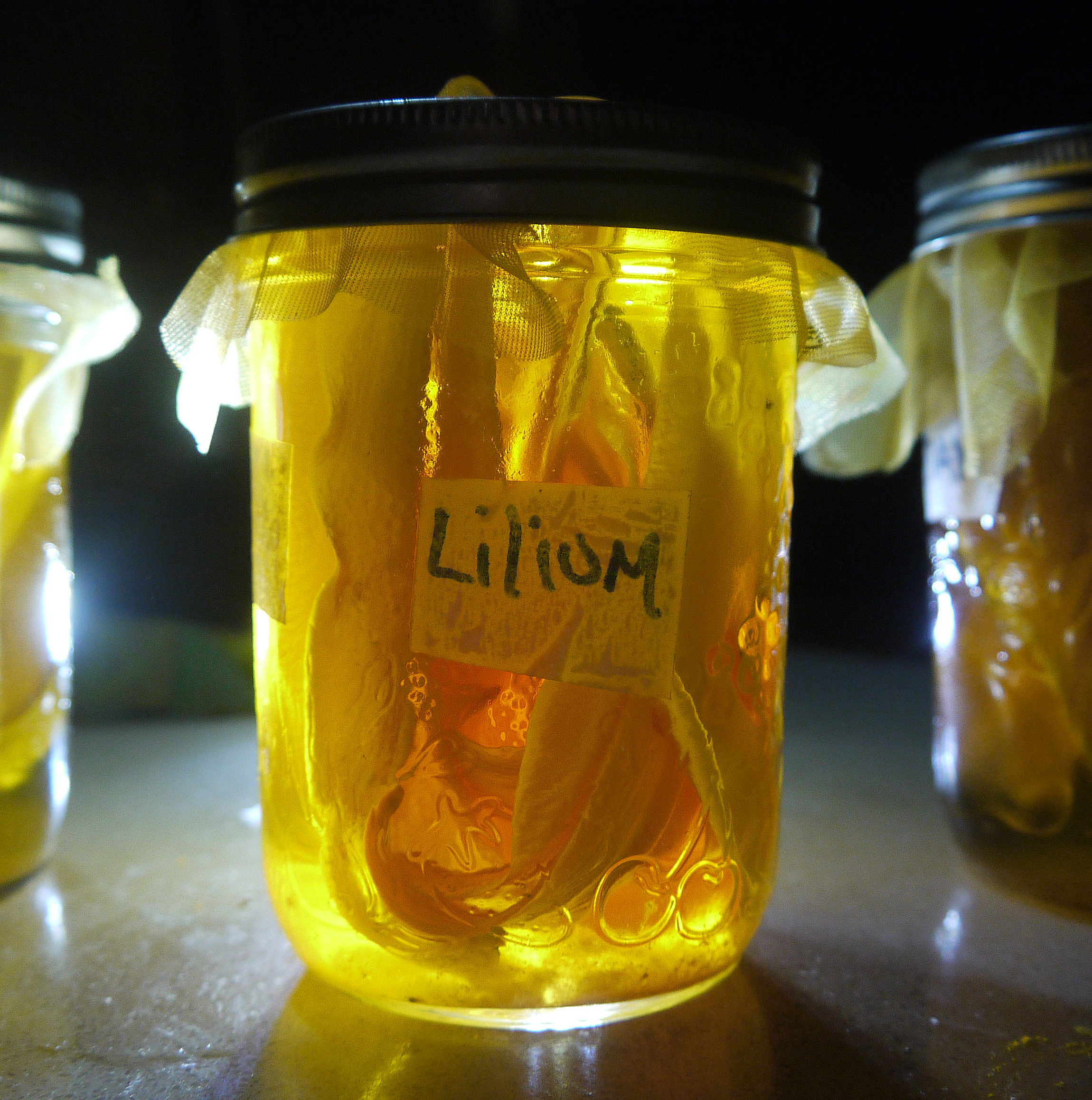
- Lilium: Made with Kua Myrrh resin (Commiphora kua) and Calamus root (Acorus calamus) as the base.
- The Minoan: Made with Labdanum resin (Cistus criticus) and Bee Propolis as the base
Price: CAD$110.00
“Oil of Lilies” comes in a 25ml amber glass flask with a ground glass stopper. The flask is sealed with natural, vegan wax for shipping
The Story of Oil of Lilies
Every summer, for many years, I have been experimenting with making “Oil of Lilies”. I grow 50 Lily plants that bloom over 45 days. While not all lilies smell exactly the same, my favorites have a core scent that all speak the same language. I follow the processes from the historical formulas. These written records have many twists and turns, sometimes deliberately obscure. The perfumed arts have always had a secretive world. The fragrant and medicinal properties of Oil of Lilies was renowned throughout the ancient world. Thousands of years ago, the heavily floral and musky smell of Lily flowers was one of the first flower fragrances to be turned into perfume. As early as 4000BC, the production of Oil of Lilies occurred on a mass scale in Egypt, Cypress and Syria. There is a mural carved on the walls of an ancient Egyptian temple, that depicts the entire process of making oil of lilies, from harvesting in the fields to offering of the finished oil to the Pharoah. Today, there are absolutely no commercial productions of real Lily flower extracts. A fragrance and medicine that was omnipresent in the ancient world has vanished from our lives.
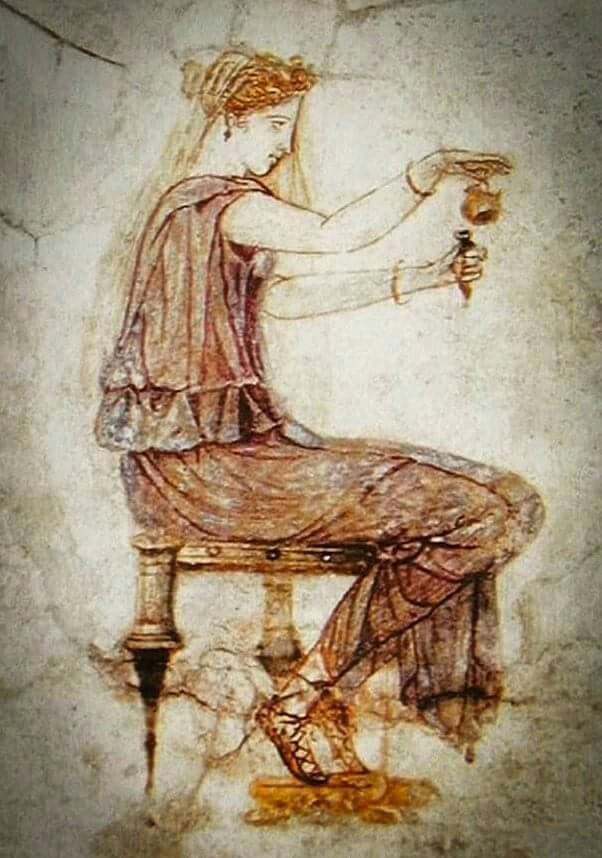
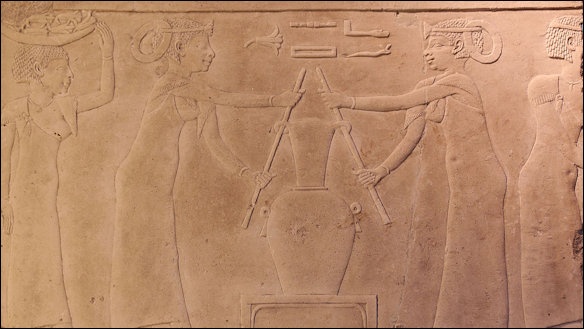
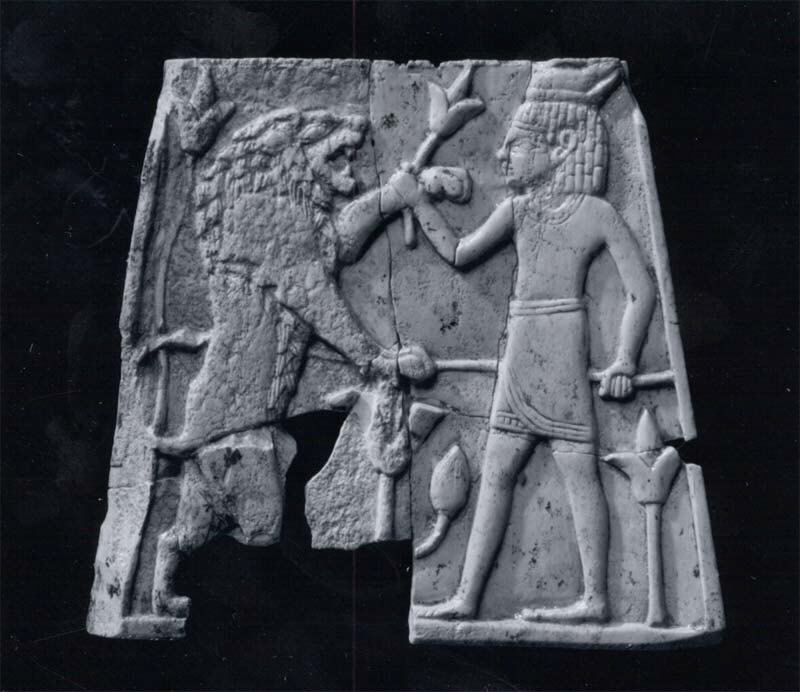
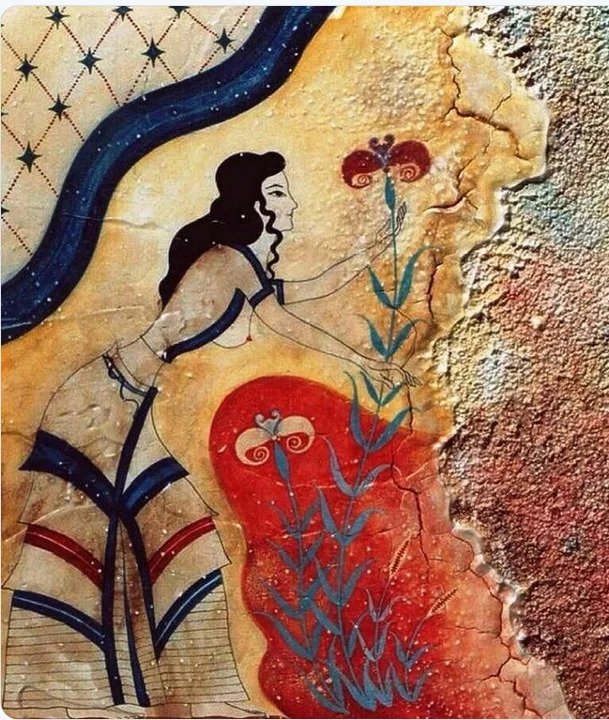

The most famous formula for Oil of Lilies was known as “Susinum”. Susinum was an Egyptian recipe that was written down by Dioscorides. He recorded that you need 1000 lilies! A fact which, when I first considered following his formula, I found a bit daunting. I thought that I would scale down his formula to not need so many flowers. Like most artistic processes, and life in general, it is in the doing that you discover the way. I quickly realized that either someone had either misinformed Dioscorides, or that he used the term “1000 lilies” to imply a lot of lilies. When I followed the directions precisely, using the original amounts, there is no way the resulting volume of oil would cover 1000 lilies unless they were very, very, very tiny. Furthermore, there is evidence that the Lilies used for making the perfumed oil were large. A Lily depicted on a Limestone fragment from the 26th Dynasty Lily demonstrates women making Oil of Lilies. It is clearly a large Lily, like a “Madonna Lily” (Lilium candidum). After quite a bit of experimentation, I believe that what was meant by “1000 Lilies”, is that the base oil maceration needs to be recharged over and over again with flowers, for at least a month, as well as being exposed to Lilies not submersed in oil, breathing their fragrant breath into the maceration. A kind of double extraction. Heaping lilies in and on top of the liquid. Using perhaps not exactly 1000 lilies, but certainly a lot of lilies. Over the years, I have developed my own equipment and methods for a small-scale production for this double process.
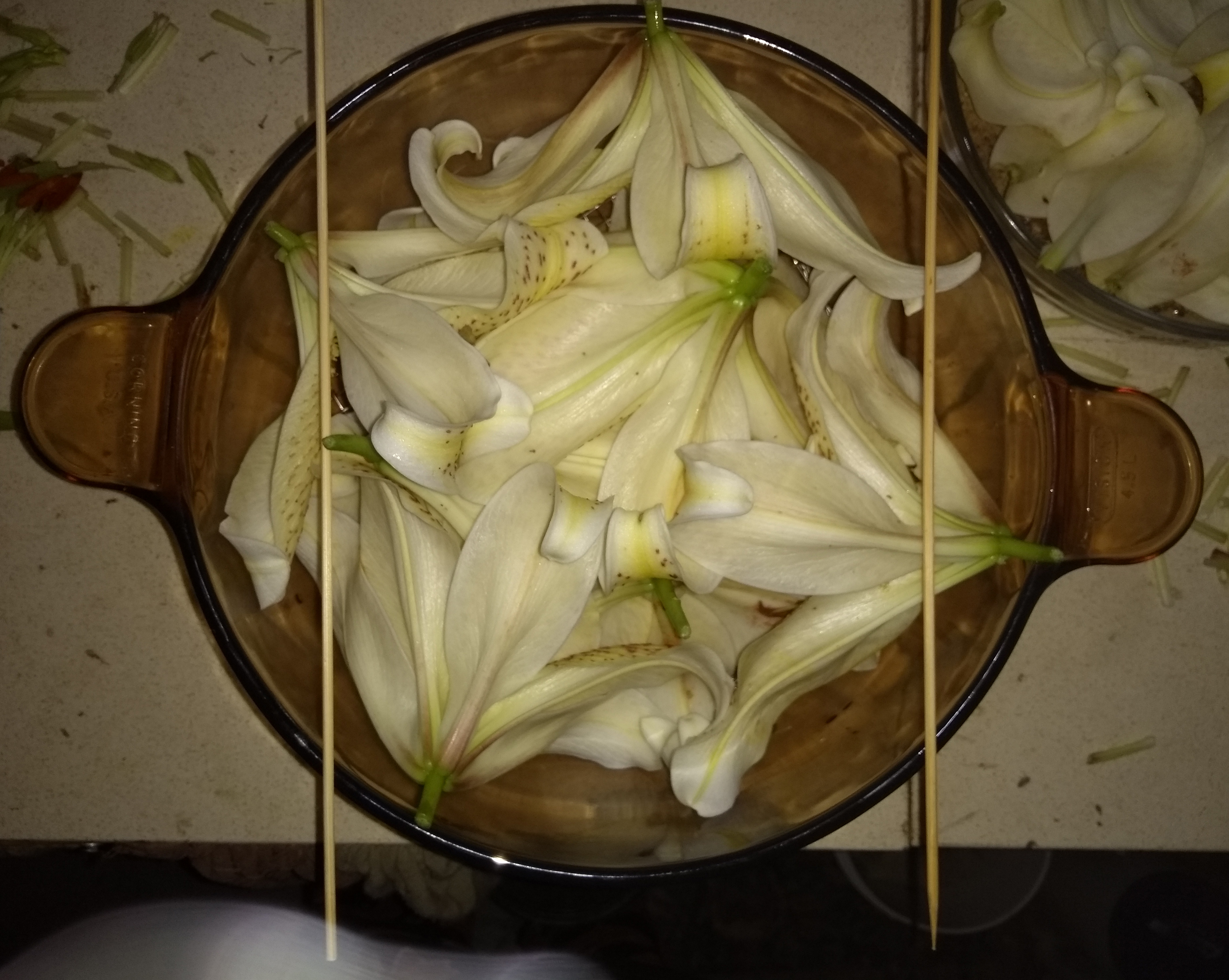
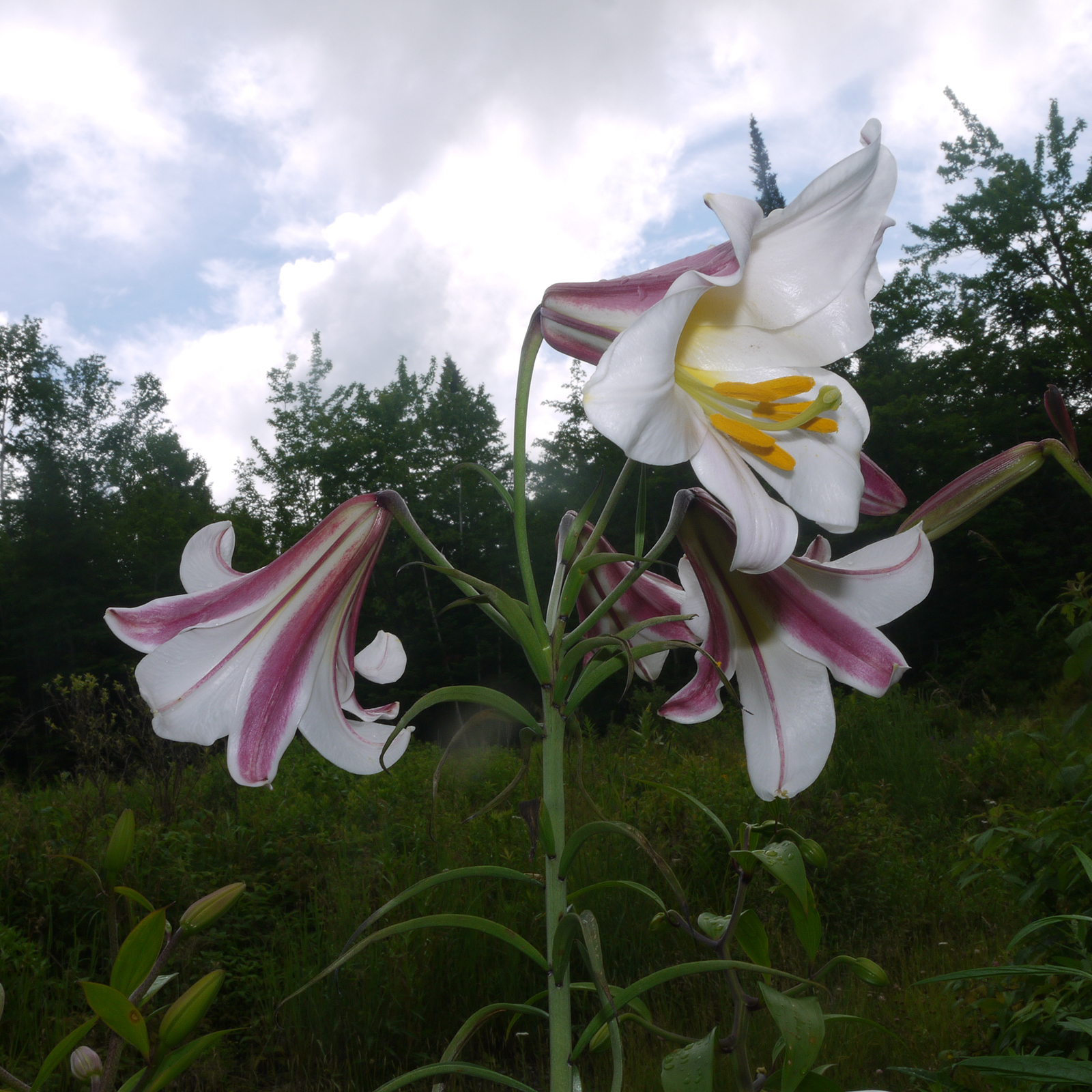
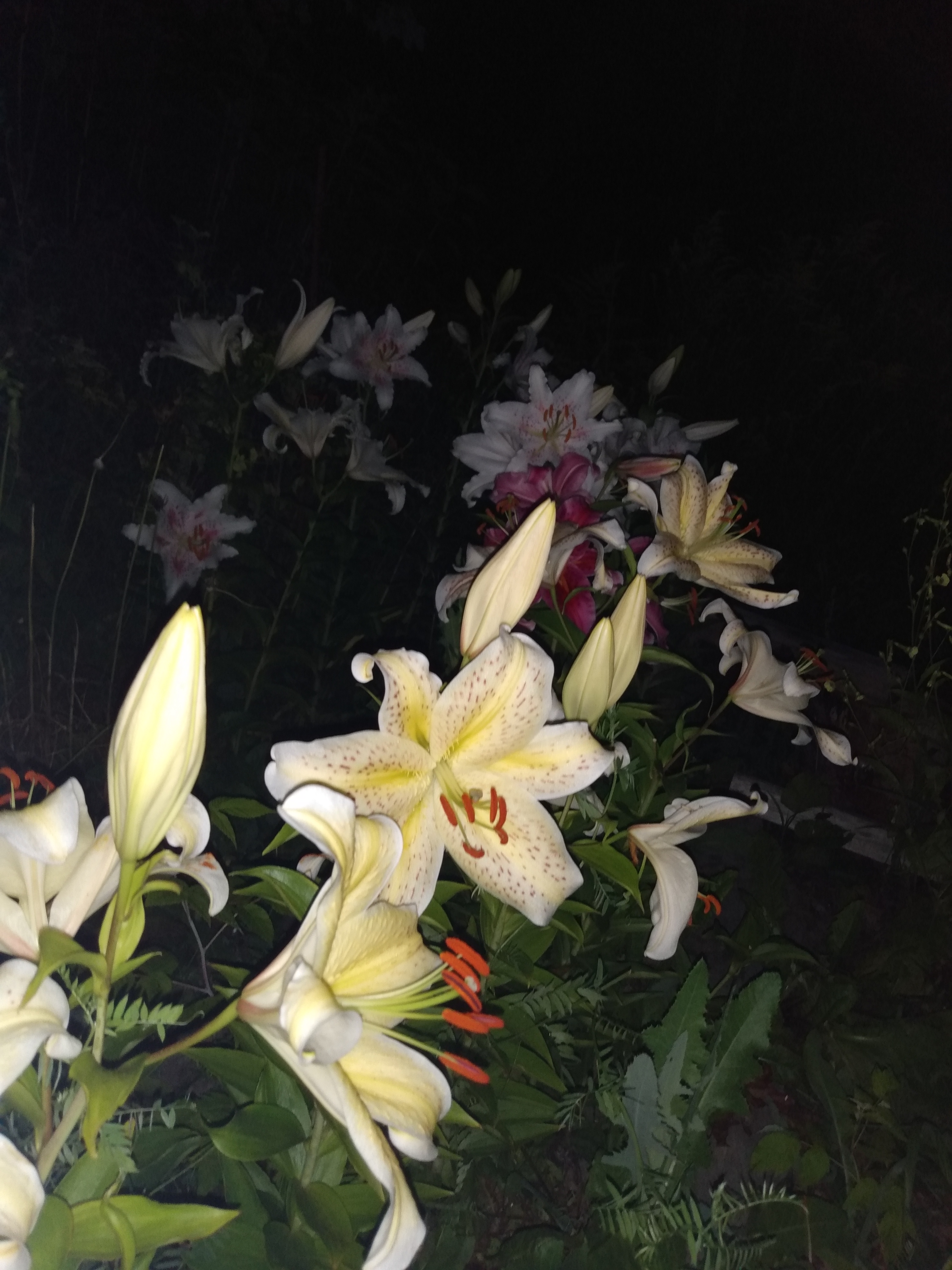

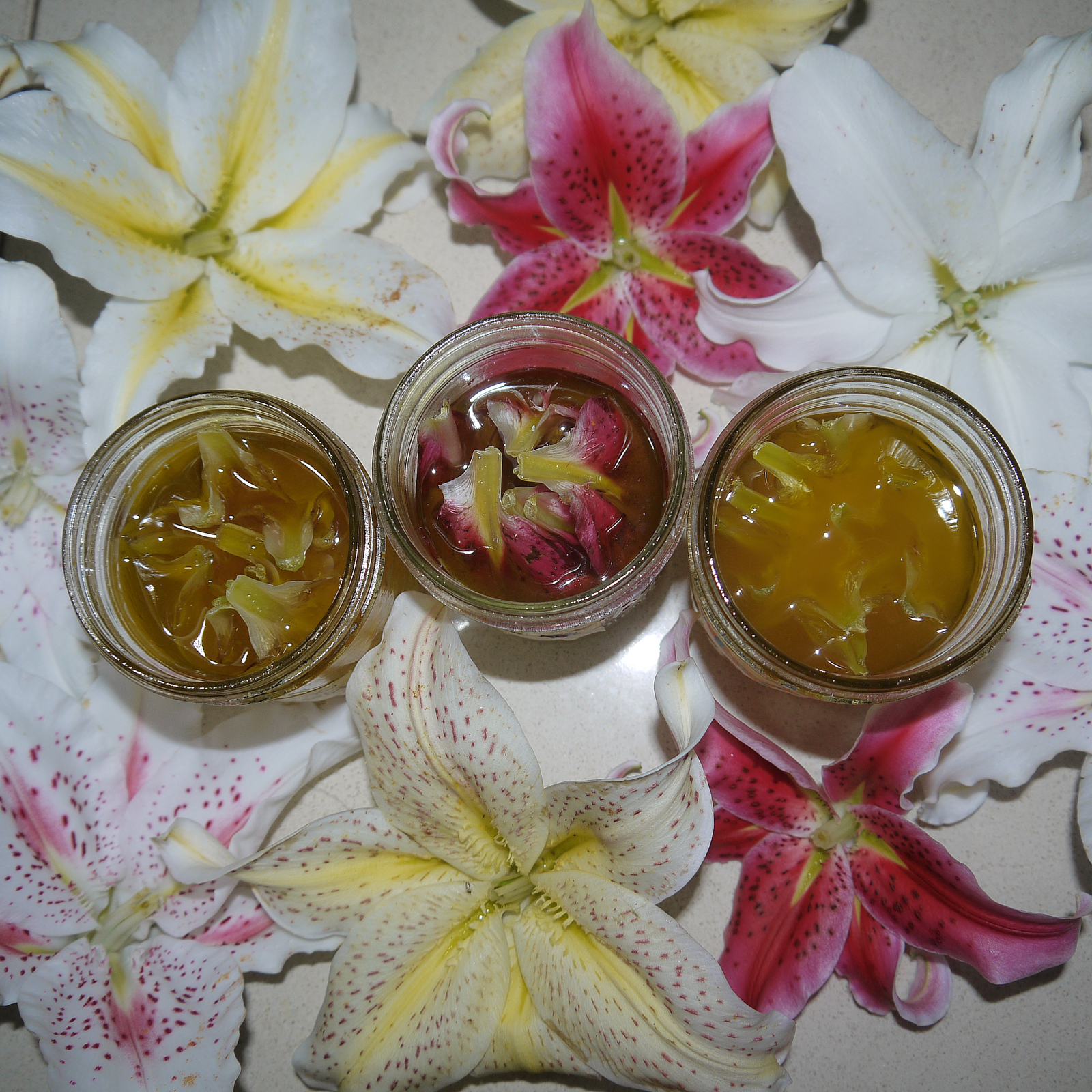
My Oil of Lilies
I made Oil of Lilies using two different jojoba oil bases. I use jojoba oil instead of balanos oil because it is far easier for me to obtain and has very similar medicinal and fragrant properties. The first variation, I call “Lilium”. It follows the ancient recipes that call for myrrh and calamus to be infused in the oil. I have always liked rich floral scents offset with myrrh. The addition of calamus, which is a plant root that I wildcraft every fall, brings the base up to a whole other level. Creamy and milky, yet spicy and bitter-sweet, the base is a perfume unto itself before I even add the lilies. The second Oil of Lilies blend, I call “The Minoan”. It has a base infused with labdanum resin from Crete, and bee’s propolis. This base is fleshy and feral with a hint of sweetness and honey. It is a perfume I can well imagine the Minoan’s knew because in the ancient world they were renowned perfumers, beekeepers, and flower gardeners. If we can judge by the number of times lilies are depicted in Minoan artwork, lilies were an important part of Minoan society. The main Minoan goddess was a moon goddess as well as a fertility goddess and when she sat on her throne, a lily grew at her feet. Female attendants offered her bunches of lilies. At night, under the full moon, barefoot ritual dances would take place across the fragrant lily fields, watched over by the goddess. Lilies have deep roots, not only physically but metaphysically. I have been trying to discern why she is associated with women, ancient goddess, breasts, nourishing and the Milky Way. I have smelled deeply and listened to her breath. I have read widely and spoke with wise women. I am beginning to understand.


Medicinal Properties
Almost all ancient fragrance oils were used, not only for their scent, but also for their medicinal properties. Aroma-therapeutically, the smell of Oil of Lilies lifts anxiety and insomnia. Applying the oil topically was traditionally used to relieve muscle pain and heal damaged skin. Oil of Lilies also helped cure hardening of the womb, masses of the uterus, and ulcers. Oil of lilies was an important ingredient in many ancient recipes for pessaries. Pessaries are devices or compound substances that are inserted into the vagina to help support a prolapsed uterus or act as a barrier method of birth control. Lily flowers were considered a check on menstruation, and there is no doubt with the amount of myrrh in the formula, that the Oil of Lilies would have a contraceptive effect. Myrrh was a known contraceptive at the time. Soranus of Ephesus, a Greek physician who was an expert on gynecology and midwifery, wrote that when used in a pessary, myrrh oil would work as an abortifacient, preventing the implantation of fertilized eggs. The idea of a perfumed pussy as a contraceptive aid is just so beautiful.

The Lily in Ancient Culture
The spirit of Lily has accompanied we-humans for a long time. Lily flowers have ancient roots which predate the last ice age. Fragrant, edible, medicinal, and perennial, no flower is more steeped in history, except perhaps the rose. To the Greeks, Lily was “the flower of all flowers”.
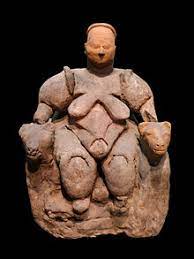
Lily is the flower of the great goddesses Inanna (Sumerians), Isthar (Akkadians, Babylonians, and Assyrians), Isis (Egyptians), Juno (Romans), Hera (Greeks), Sophia (Hebrew-Christian) and all the fragmented goddesses of the feminine Christian trinity: Lilith/Eve/Mary. The scepter of the goddess/queen in Crete was surmounted by a Lily. Lily is one of the flowers associated with a host of minor goddesses associated with the ecstatic nights under the moon that lead to rebirth: Britomartis/ Diktynna (Crete), Artemis (Greek), Diana (Roman), Persephone (Greek) and Susana (which means Lily in Hebrew). Lilies also have an important place in Traditional Chinese Medicine and Tibetan Medicine and, once again, culturally they are used as a symbol of marriage and fertility.
Lilies presence in so many cultures as a symbol for women and rebirth, coupled with Lily’s use as women’s medicine, speaks to her prehistoric origins as an important plant in the women’s mystery traditions. Passed along through oral tradition from mother to daughter, grandmother to granddaughter, teacher to student, the women’s mystery traditions were symbolic teachings that taught women both practical medicine, how to work with the energy of emotion, and attune themselves to the dimension of dreams, portents, and visions.
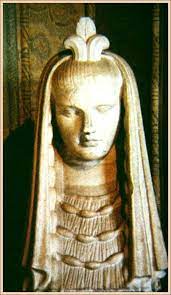
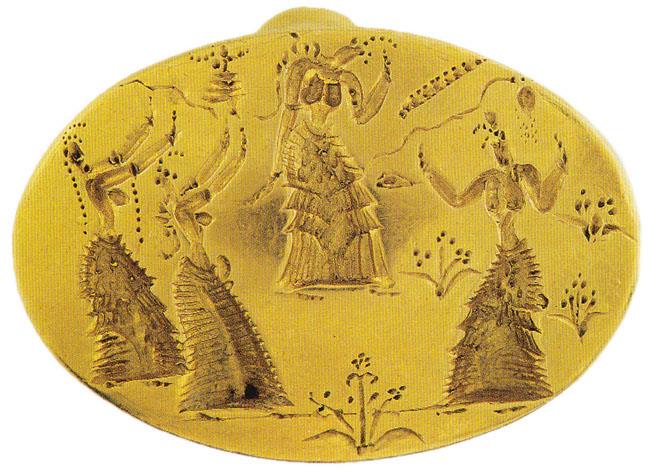

There is a fascinating gold signet ring (1500 – 1450 BC) from Crete that depicts a sisterhood of bare-breasted priestesses with the heads of bees, the milk of their breasts flowing towards the Galaxy. The women are in ritual ecstatic positions. As indicated by the single disembodied eye and the epiphany of a goddess floating in the center of the sky, the scene is a ritual of plant-gathering in which the women are having a visionary experience. The women are surrounded by Lilies. A wavy line separating the priestesses from the goddess terminates in a celestial “breast shaped” ampule or vessel, a container for the elixir of the gathered plants, or the lactation from their breasts. The Minoan temples aligned with the stars and seemed to have rituals dedicated to cosmic alignments. Some scholars have suggested that this signet ring may be the earliest depiction, dateable to the mid second millennium, of the conjunction of the lilies with the milk of the Galaxy
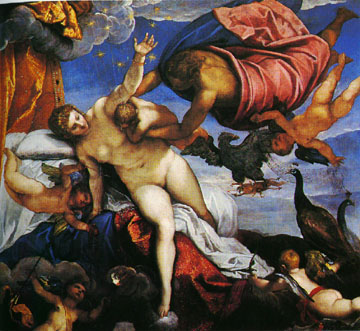
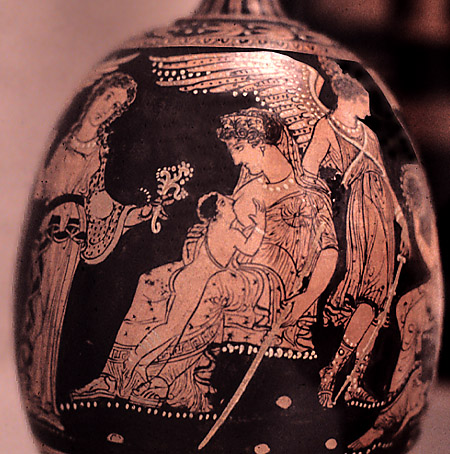
There are other clues to the deep relationship that Lilies has with breast milk and the sacred feminine in the Greek Myth of Hercules and Hera. Classical Greek myths are deeply patriarchal and “civilized”. They are often revisions of earlier spiritual traditions that were closer to nature and the feminine. In Greek mythology, strong female power is deliberately warped and rewritten in a negative light to support the patriarchal paradigm. Hera, the goddess of women, marriage, birth, and seasonality, had great hostility towards Hercules, the archetypically, martial, Heroic Man. This could indicate the transformation of theology from the Paleolithic and Neolithic women-centered cultures, to the more martial and patriarchal Bronze Age. In the myths about Hera and Hercules, he injures her breast twice. Hera breast feeds Hercules twice, once when he is a child and another time when he is an adult. Perhaps, a way of saying that the Great Mother has nourished and given birth to martial man. As a child, Hera suckled Heracles and he drank so voraciously that some of the milk scattered to the heavens, becoming the Milky Way or Galaxy. The word galaxy comes from the root word gala, which means milk. What fell to the earth sprouted as the lily (leírion) which explains why lilies smell so sweet. This connection of Lilies to the Milky Way points to Lilies’ association to birth, rebirth, and the breast. In almost every ancient culture around the world, the Milky Way was considered the white road or milk road that all life traveled when they entered or left life on earth. Recently, I found it significant that a very good friend of mine, a great leader and spiritual seeker, surrounded herself with fragrant Lilies during the months before she was going to die.

My Experience with Lilies
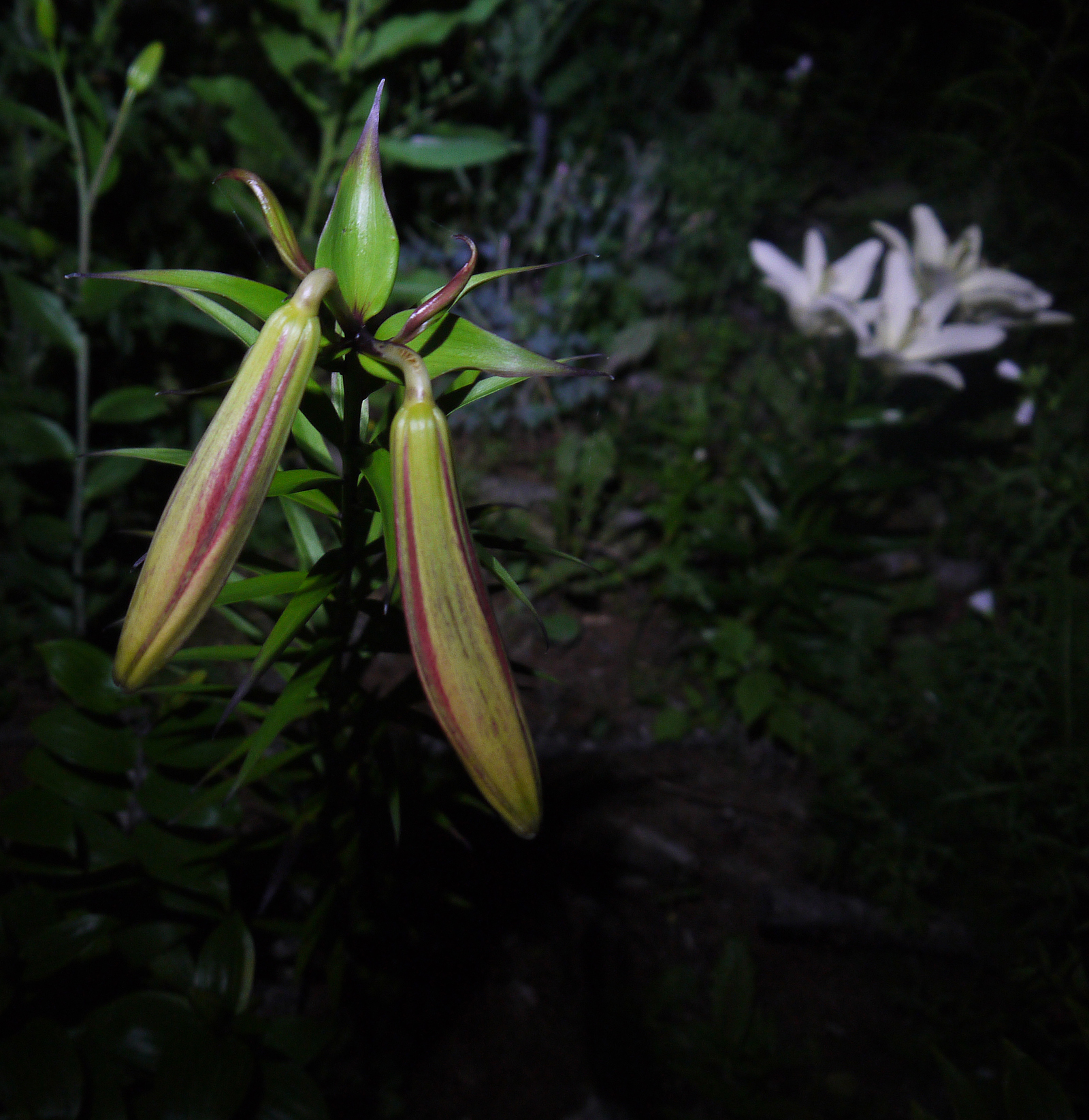
Long before I read anything about Oil of Lilies, or knew anything about Lilies association with the Milky Way, the scent of Lilies fascinated me. The sensation I got from their presence and fragrance was pleasurable, and also, strangely, a feeling, a dim memory, of being held and loved. It has taken me years to understand why. I would stand among the Lilies in my garden and inhale deeply trying to recall the original scent-scape. More of a feeling than a thought, the memory eluded me. It was during one of my many sessions of ethnobotanical research on Lilies that the memory came flooding back, like a warm wave. I realized the fragrance of Lilies echoes the smell of nursing at my mother’s breast. Not because my mother wore any kind of Lily perfume or there were Lilies in the environment, but because there is something in the smell of lilies that echoes the scent of my mother’s lactating breast. I had this epiphany when I read the ancient myth of Hera and Hercules. This association of milk and Lilies triggered me, because I was nursed by my mother for four long years, which she often described as one of the best times in her life. This is where my deep associations of the fragrance of Lilies came from. I am just a reverberation of the whole.



Who Is Lily?
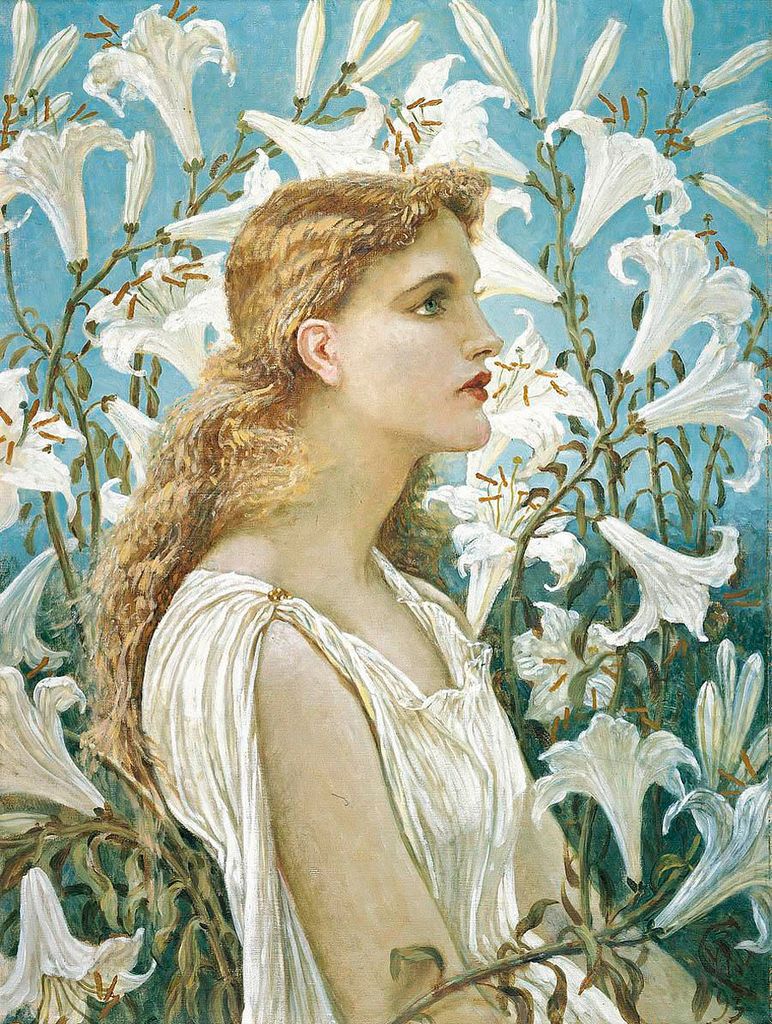
Just who is this nature spirit we call “Lily” who has traveled through time with humans through the last ice age, and what is at the root of our relationship with her? Lily is a hardy survivor. Lily can survive in temperatures down to −34.4 °C (−30°F) and is an independent, self-pollinator. Characteristics that have led her to ability to spread across the globe. Lilies bulbs are subterranean buds. Bulbs are perennial, persisting for years. The most significant difference between simple root and bulb plants is their tolerance to adverse conditions. Lilies have contractile roots and can pull themselves down deeper in the soil when stimulated by the heat of a fire, drought, bitter wind, or ice. Lily can wait a long time underground to emerge when conditions improve. She is not just sitting under ground waiting to bloom she is managing her space for growth and expansion through subtle movements. All Lilies can reproduce by scales that grow as layers on their bulbs and some produce little bulblets that form on their stems which look like seeds. Lily doesn’t need pollinators, but she does like to have help loosening the soil around her mother bulb and dispersing her scales and bulblets. A task that foraging humans admirable perform. It is believed that even before the full development of agriculture, human’s relationship with edible roots and tubers had shifted from predation to mutual benefit.
The Earth was struck by a meteorite or asteroid 12,800 years ago. The results of the impact had global consequences, including climate change, and contributed to the extinction of many species of large animals that our ancestors hunted for food. Immediately after the extinction of the mammoth, birch forests replaced the grasslands and an era of significant fire began, as well as long term cooling. Large animals, the main food source for humans, died, but Lily would have survived tucked under an insulating layer of soil near the edges of the glaciers, in what is considered Lilies home in the Balkans and the Middle East. Exactly the places where there was an ice-free corridor during the last glaciation.
The cultivation of lilies must be extremely old because the plants are not only fragrant but because the bulbs are edible. In Asia the bulbs are a common food. The flavor of the bulbs is excellent. They have a natural sweetness that intensifies as you cook them. Sautéed, they are crunchy and sweet, a bit like water chestnuts. I can only imagine the feeling of our hungry ancestors, seeing the lily spears rise from the earth in early spring, knowing there was a delicious, edible tuber below. As the Lily buds swelled, they would have appeared as unbound breasts. Then at blossoming time, fields of glorious, six petaled flowers, seen from afar, must have appeared as stars, like a terrestrial milky way. They would have appeared, not in twos and threes like in my garden, but in hundreds, in thousands, even in tens of thousands. Their flowers floating 2-4 feet high floating above their stiff stems. The breath of tens of thousands of flowers filling the warming. Lily would have appeared the incarnation of a living Mother Goddess.
 Oil of Lilies